
Fundamental Rights under the Indian Constitution: Scope, Protection and Contemporary Challenges
Keywords:
Fundamental Rights, Indian Constitution, Article 14, Article 19, Article 21, Article 32, PrivacyAbstract
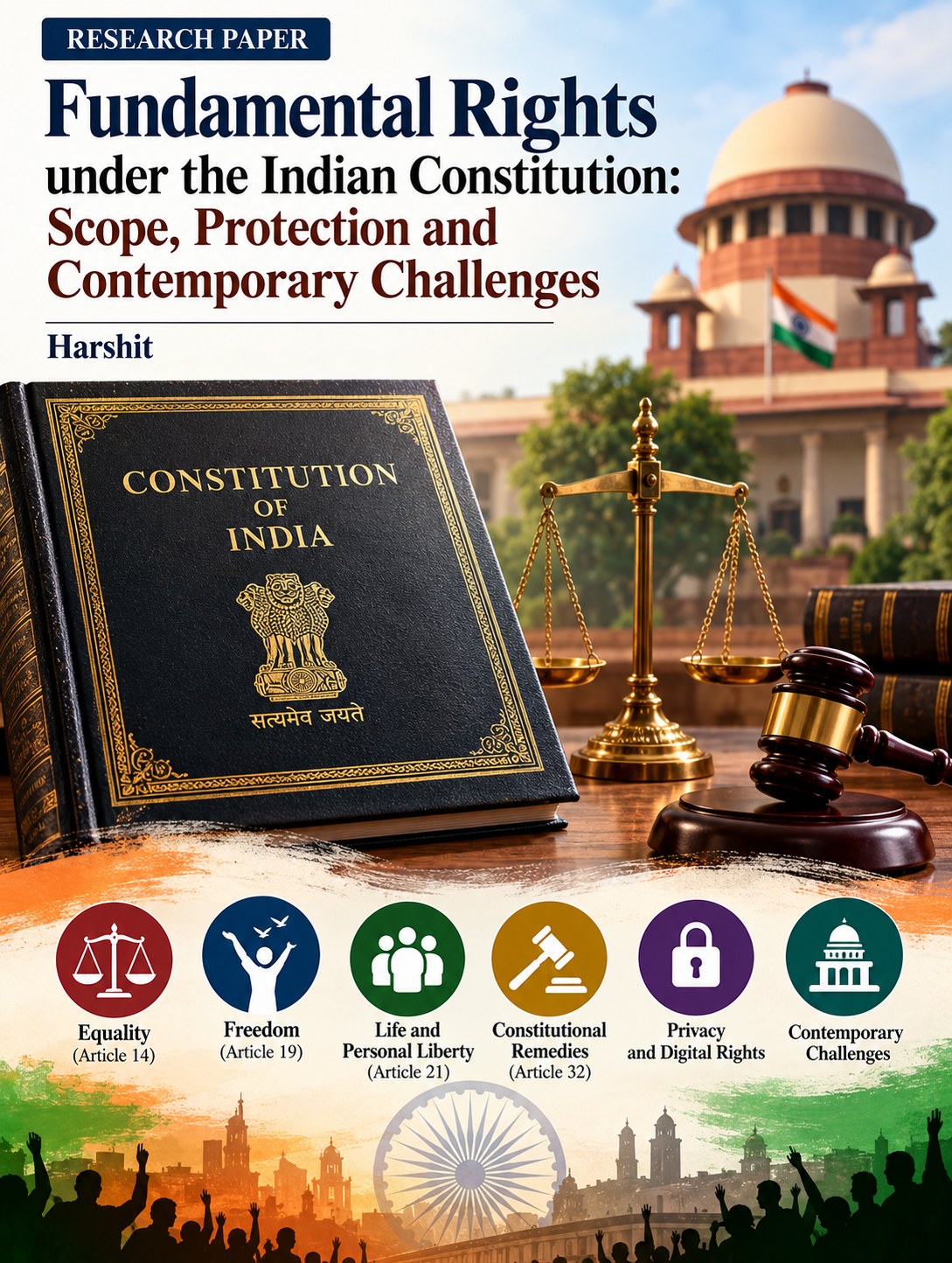
Fundamental Rights constitute the constitutional foundation for the protection of equality, liberty, dignity and democratic participation in India. Enshrined primarily in Part III of the Constitution under Articles 12 to 35, these rights impose constitutional limits on State power and provide enforceable protections to individuals. This paper examines the scope of Fundamental Rights, mechanisms for their protection, major developments in judicial interpretation, and contemporary challenges arising from digital technology, privacy, internet restrictions, freedom of expression, equality, religious liberty and personal liberty. The study adopts a doctrinal and analytical methodology based primarily on the Constitution of India, Supreme Court judgments and selected academic literature. Particular attention is given to Articles 14, 19, 21 and 32 and landmark decisions including Kesavananda Bharati, Maneka Gandhi, Shreya Singhal, Justice K.S. Puttaswamy and Anuradha Bhasin. The analysis finds that Fundamental Rights have developed through constitutional interpretation from textual guarantees into a broader framework protecting dignity, autonomy and liberty. At the same time, constitutional rights remain subject to legally authorised restrictions. The paper concludes that effective rights protection requires constitutional remedies, independent judicial review, proportionality, institutional accountability and constitutional awareness.
Downloads
References
Anuradha Bhasin v. Union of India, (2020) 3 SCC 637. https://api.sci.gov.in/officereport/2020/28801/28801_2020_2022-10-10_704.html
Constitution of India. (1950). Government of India, Legislative Department. https://www.legislative.gov.in/constitution-of-india/
Joseph Shine v. Union of India, (2019) 3 SCC 39. https://www.sci.gov.in/
Justice K.S. Puttaswamy (Retd.) v. Union of India, (2017) 10 SCC 1. https://api.sci.gov.in/supremecourt/2012/35071/35071_2012_Judgement_26-Sep-2018.pdf
Kesavananda Bharati v. State of Kerala, (1973) 4 SCC 225. https://www.sci.gov.in/document/his-holiness-kesavananda-bharati-v-state-of-kerala-1973-supp-scr-1/
Maneka Gandhi v. Union of India, (1978) 1 SCC 248. https://www.sci.gov.in/
Modern Dental College and Research Centre v. State of Madhya Pradesh, (2016) 7 SCC 353. https://www.sci.gov.in/
Navtej Singh Johar v. Union of India, (2018) 10 SCC 1. https://www.sci.gov.in/
Shayara Bano v. Union of India, (2017) 9 SCC 1. https://www.sci.gov.in/
Shreya Singhal v. Union of India, (2015) 5 SCC 1. https://api.sci.gov.in/officereport/2025/7547/7547_2025_2025-03-03_355.html
Supreme Court of India. (n.d.). Judgments and case records. https://www.sci.gov.in/
Vishaka v. State of Rajasthan, (1997) 6 SCC 241. https://www.sci.gov.in/
Downloads
Published
Issue
Section
License
Copyright (c) 2026 Harshit Patel (Author)

This work is licensed under a Creative Commons Attribution 4.0 International License.