INTELLECTUAL PROPERTY RIGHTS: CONCEPT, LEGAL FRAMEWORK, IMPORTANCE AND CONTEMPORARY CHALLENGES
Keywords:
Intellectual Property Rights, Patents, Copyright, Trademark, Geographical Indication, TRIPSAbstract
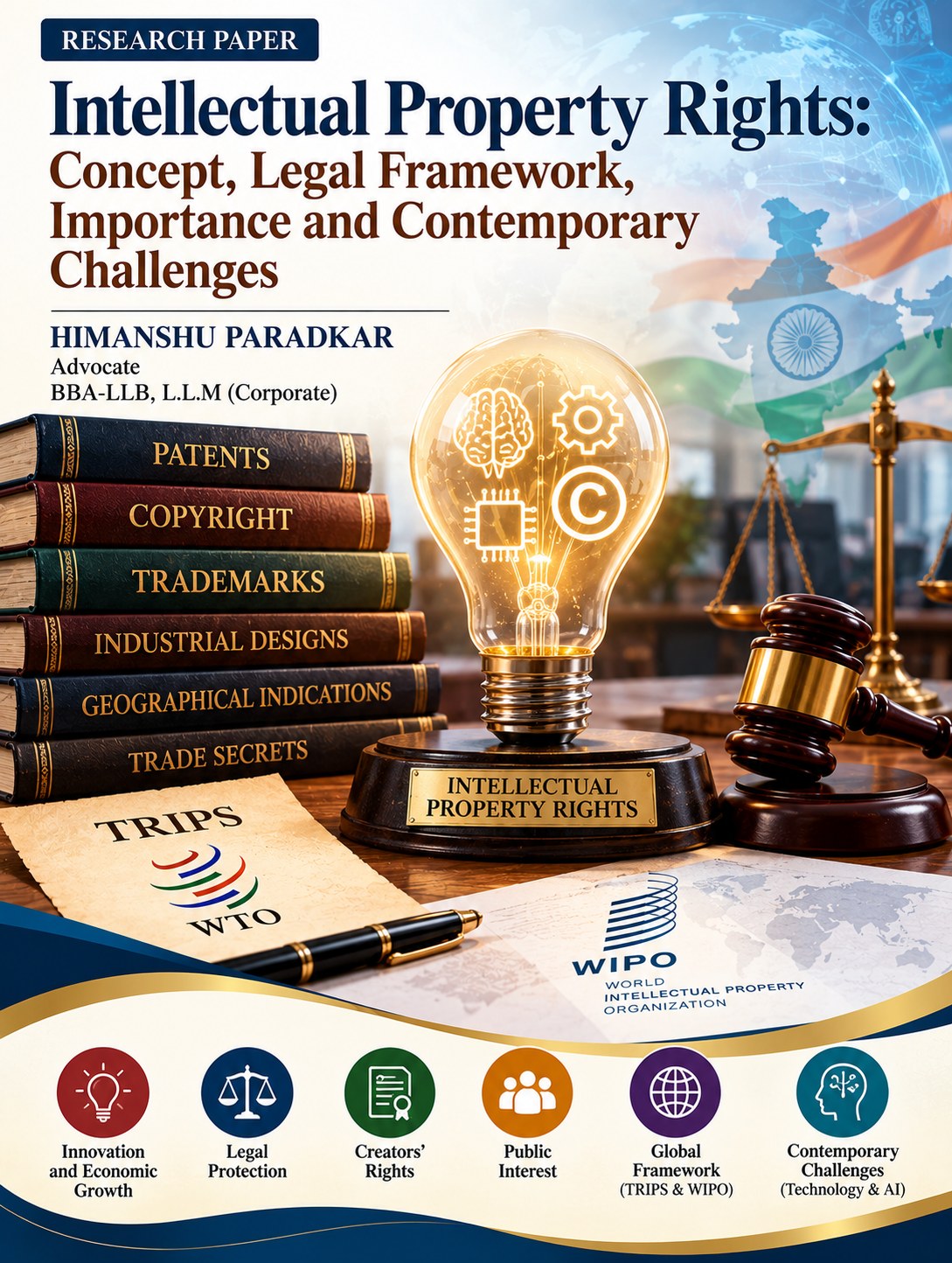
Intellectual Property Rights (IPR) constitute an important component of the modern legal and economic system because they provide legal protection to creations of the human intellect. Inventions, literary and artistic works, designs, trademarks, geographical indications and confidential commercial information represent valuable intellectual assets that contribute to innovation, economic development and cultural progress. The intellectual property system attempts to create a balance between the interests of creators and innovators and the wider interests of society. The international framework for intellectual property protection has been significantly influenced by the World Intellectual Property Organization (WIPO) and the Agreement on Trade-Related Aspects of Intellectual Property Rights (TRIPS) administered by the World Trade Organization (WTO).
India has developed a comprehensive intellectual property framework comprising legislation relating to patents, copyright, trademarks, industrial designs and geographical indications, along with mechanisms for enforcement and international cooperation. The Indian system has also evolved in response to technological developments, globalization and India's obligations under TRIPS. Contemporary challenges include digital piracy, online trademark infringement, artificial intelligence-generated content, protection of traditional knowledge, access to medicines, enforcement difficulties and the increasing commercialization of intangible assets. This research paper examines the concept and major categories of IPR, the Indian legal framework, international obligations, significance of IPR and contemporary challenges. The paper argues that effective IPR protection requires an appropriate balance between private rights, innovation incentives, competition and public interest.
Downloads
References
Government of India, Office of the Controller General of Patents, Designs & Trade Marks. (2026). Basics of patents. Intellectual Property India. https://www.ipindia.gov.in/basics-of-patents
Government of India, Office of the Controller General of Patents, Designs & Trade Marks. (2026). Intellectual Property India. https://ipindia.gov.in/
World Intellectual Property Organization. (2020). What is intellectual property? WIPO. https://www.wipo.int/en/web/about-ip
World Intellectual Property Organization. (2026). Explore IP landscape: India. WIPO. https://www.wipo.int/en/web/country-profiles/IN
World Intellectual Property Organization. (2026). WIPO Lex: Member profile, India. WIPO. https://www.wipo.int/wipolex/en/members/profile/IN
World Intellectual Property Organization. (2026). Patent system of India. WIPO Patent Judicial Guide. https://www.wipo.int/patent-judicial-guide/en/full-guide/india
World Trade Organization. (2026). Trade-related aspects of intellectual property rights: TRIPS. WTO e-TRIPS Gateway. https://e-trips.wto.org/
World Trade Organization. (2024). A handbook on the WTO TRIPS Agreement. WTO. https://www.wto.org/english/res_e/publications_e/handbook_wtotripsag12_e.pdf
Downloads
Published
Issue
Section
License
Copyright (c) 2026 Himanshu paradkar (Author)

This work is licensed under a Creative Commons Attribution 4.0 International License.