
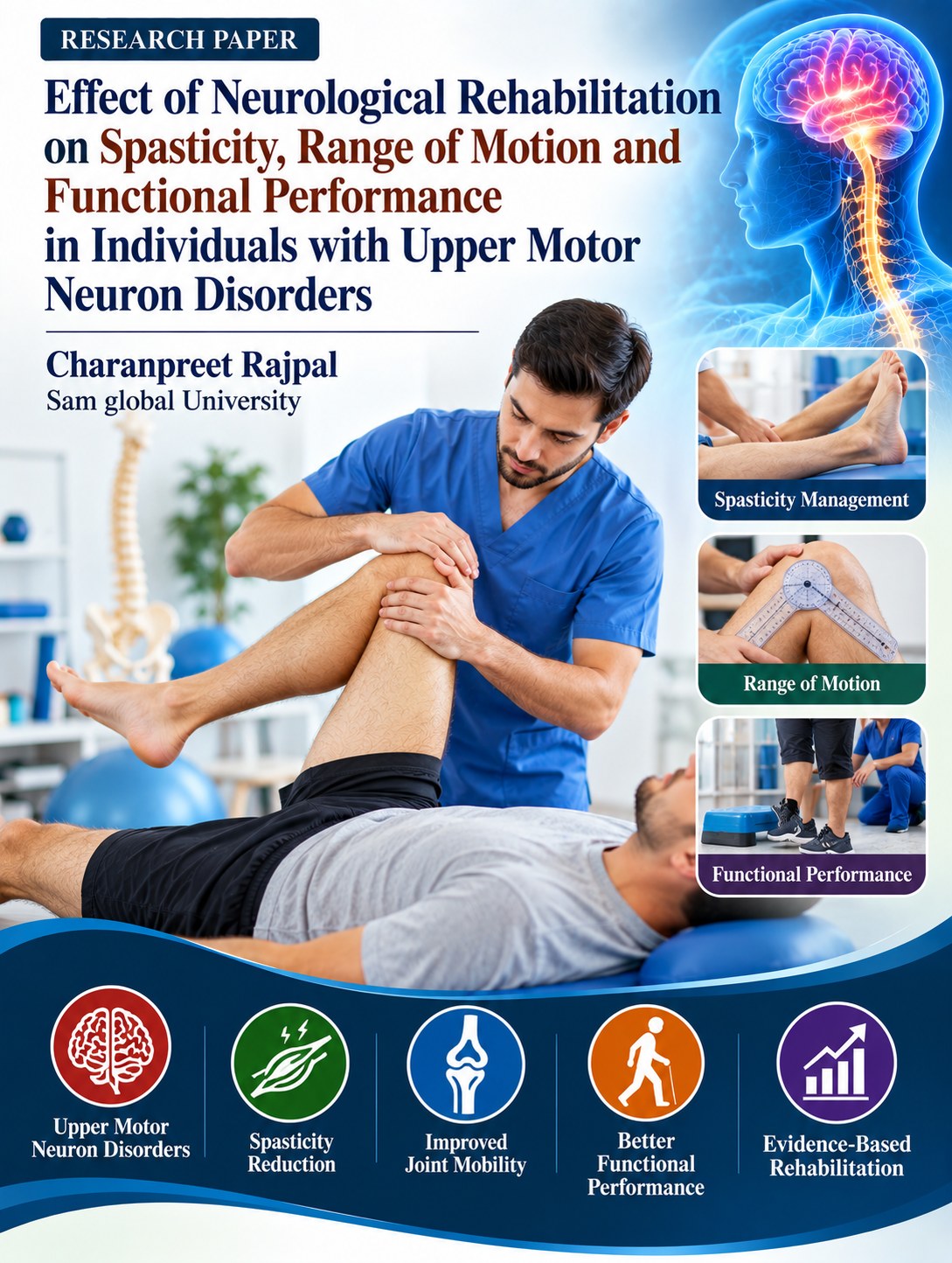
Effect of Neurological Rehabilitation on Spasticity, Range of Motion and Functional Performance in Individuals with Upper Motor Neuron Disorders
Keywords:
Upper motor neuron disorders, neurological rehabilitation, spasticity, range of motion, functional performance, physiotherapyAbstract
Background: Upper motor neuron (UMN) disorders may be associated with spasticity, weakness, abnormal movement patterns, restricted joint range of motion and reduced functional performance. These impairments can interfere with mobility, upper-limb use and activities of daily living. Neurological rehabilitation combines positioning, stretching, active movement, task-specific training and functional practice to address these impairments.
Aim: To evaluate the effect of a structured neurological rehabilitation programme on spasticity, range of motion and functional performance in individuals with upper motor neuron disorders.
Methods: A pre-test and post-test interventional design may be used among adults with clinically diagnosed UMN disorders. A six-week rehabilitation programme, delivered five sessions per week, may include range-of-motion exercises, stretching, strengthening, weight-bearing, task-oriented training and functional activities. Spasticity may be assessed using the Modified Ashworth Scale (MAS), joint mobility using a universal goniometer, and motor performance using the Fugl-Meyer Assessment (FMA). Pre- and post-intervention scores may be compared using appropriate paired statistical tests.
Results: Illustrative data demonstrate how changes in spasticity, range of motion and motor performance can be presented. These values are not actual clinical observations and should not be reported as study findings.
Conclusion: A structured neurological rehabilitation programme can be investigated as a multidimensional intervention targeting tone, joint mobility and motor performance. Standardized outcome measures, consistent assessors and controlled study designs are recommended for future research.
Downloads
References
1. Fugl-Meyer, A. R., Jääskö, L., Leyman, I., Olsson, S., & Steglind, S. (1975). The post-stroke hemiplegic patient. I. A method for evaluation of physical performance. Scandinavian Journal of Rehabilitation Medicine, 7, 13–31.
2. Gao, Q., Yasu, Z., Long, J., Pan, M., Wang, J., & Yang, F. (2023). Effect of different constraint-induced movement therapy protocols on recovery of stroke survivors with upper extremity dysfunction: A systematic review and network meta-analysis. International Journal of Rehabilitation Research, 46(2), 133–150. https://doi.org/10.1097/MRR.0000000000000577
3. Gregson, J. M., Leathley, M., Moore, A. P., Sharma, A. K., Smith, T. L., & Watkins, C. L. (1999). Reliability of the Tone Assessment Scale and the Modified Ashworth Scale as clinical tools for assessing poststroke spasticity. Archives of Physical Medicine and Rehabilitation, 80(9), 1013–1016. https://doi.org/10.1016/S0003-9993(99)90053-9
4. Langhorne, P., Bernhardt, J., & Kwakkel, G. (2011). Stroke rehabilitation. The Lancet, 377(9778), 1693–1702. https://doi.org/10.1016/S0140-6736(11)60325-5
5. Meseguer-Henarejos, A. B., Sánchez-Meca, J., López-Pina, J. A., & Carles-Hernández, R. (2018). Inter- and intra-rater reliability of the Modified Ashworth Scale: A systematic review and meta-analysis. European Journal of Physical and Rehabilitation Medicine, 54(4), 576–590. https://doi.org/10.23736/S1973-9087.17.04796-7
6. Meseguer-Henarejos, A. B., et al. (2023). Reliability of the Modified Ashworth Scale after stroke for 13 muscle groups. Archives of Physical Medicine and Rehabilitation. PubMed PMID: 37121531. https://pubmed.ncbi.nlm.nih.gov/37121531/
7. Pandyan, A. D., Johnson, G. R., Price, C. I. M., Curless, R. H., Barnes, M. P., & Rodgers, H. (1999). A review of the properties and limitations of the Ashworth and modified Ashworth Scales as measures of spasticity. Clinical Rehabilitation, 13(5), 373–383. https://doi.org/10.1191/026921599677595404
8. Pérez-de la Cruz, S., et al. (2019). Intra- and inter-rater reliability of Fugl-Meyer Assessment of Upper Extremity in stroke. Journal of Rehabilitation Medicine. PubMed PMID: 31448807. https://pubmed.ncbi.nlm.nih.gov/31448807/
9. Sanford, J., Moreland, J., Swanson, L. R., Stratford, P. W., & Gowland, C. (1993). Reliability of the Fugl-Meyer assessment for testing motor performance in patients following stroke. Physical Therapy, 73(7), 447–454. https://doi.org/10.1093/ptj/73.7.447
10. See, J., Dodakian, L., Chou, C., et al. (2010). A standardized approach to the Fugl-Meyer assessment and its use in stroke rehabilitation research. Journal of NeuroEngineering and Rehabilitation, 7, 50. https://pubmed.ncbi.nlm.nih.gov/21164120/
11. Wiesner, M., Schwarz, A., Meya, A., Kaufmann, M., Traenka, C., Luft, A. R., Held, J. P., & Engelter, S. T. (2024). Interrater reliability of the Fugl-Meyer Motor Assessment in stroke patients: A quality management project within the ESTREL study. PubMed PMID: 38651097. https://pubmed.ncbi.nlm.nih.gov/38651097/
Downloads
Published
Issue
Section
License
Copyright (c) 2026 Charanpreet Rajpal (Author)

This work is licensed under a Creative Commons Attribution 4.0 International License.