
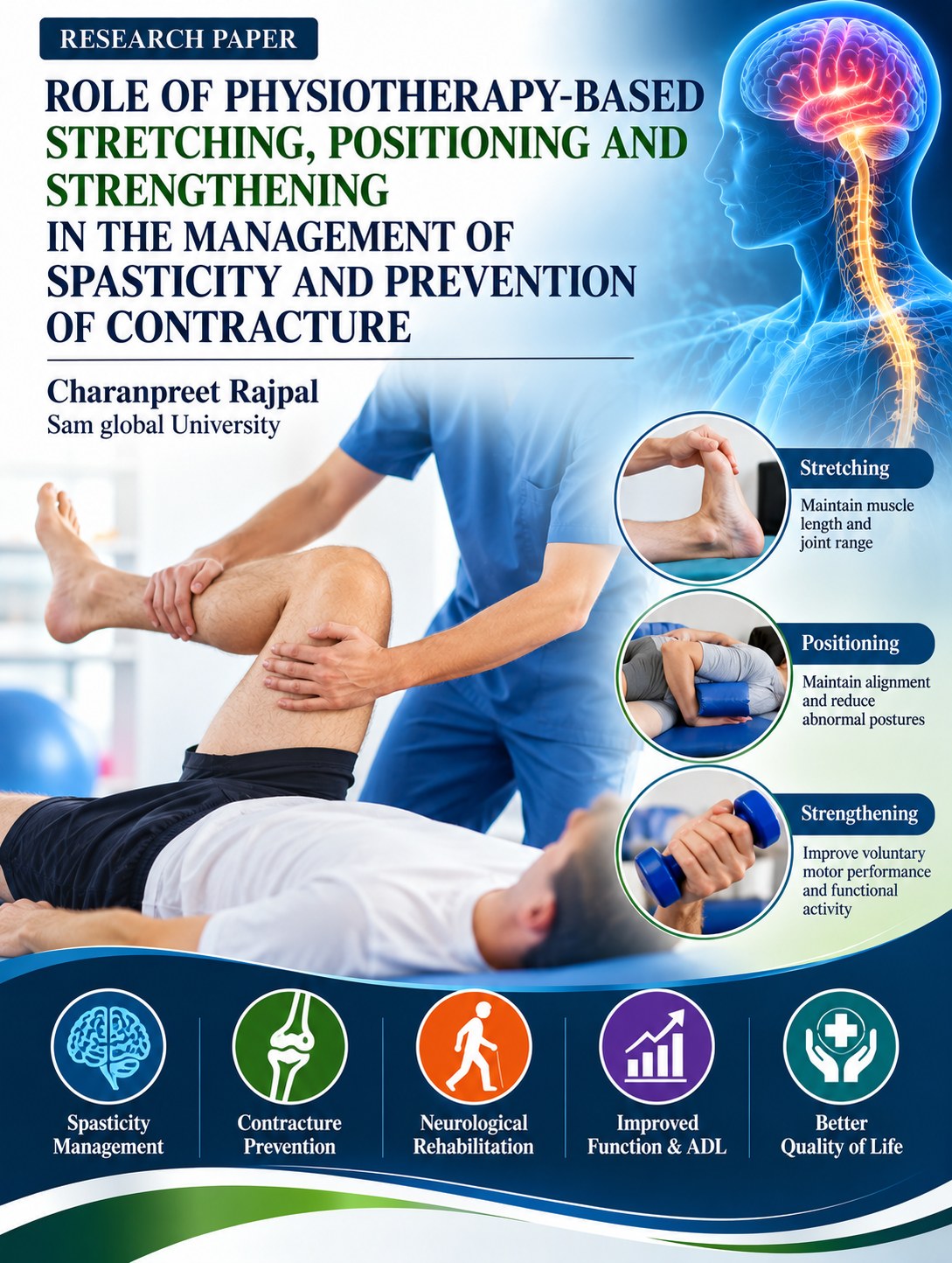
ROLE OF PHYSIOTHERAPY-BASED STRETCHING, POSITIONING AND STRENGTHENING IN THE MANAGEMENT OF SPASTICITY AND PREVENTION OF CONTRACTURE
Keywords:
Stretching, Positioning, Strengthening, Contracture, Neurological Rehabilitation, Range of MotionAbstract
Spasticity is a common motor impairment associated with upper motor neuron lesions and neurological disorders such as stroke, traumatic brain injury, spinal cord injury, cerebral palsy and multiple sclerosis. It may interfere with voluntary movement, balance, gait, activities of daily living and functional independence. Persistent abnormal muscle activity, immobility and altered biomechanics may also contribute to loss of joint range and development of contracture. Physiotherapy forms an important component of multidisciplinary management through interventions such as therapeutic stretching, positioning, strengthening, active and passive range-of-motion exercises, weight-bearing and functional training. Evidence suggests that stretching is useful for maintaining available range of motion and soft-tissue extensibility, although its sustained effect on neurological spasticity is variable (Bovend’Eerdt et al., 2008; Katalinic et al., 2011). Positioning and regular movement may help limit prolonged abnormal postures, while appropriately prescribed strengthening can address weakness and improve functional capacity (Ada et al., 2006; Morris et al., 2004). The present paper reviews the role of stretching, positioning and strengthening in spasticity management and contracture prevention. The literature supports an individualized, goal-directed programme combining tone management with active movement, strengthening and task-specific rehabilitation rather than relying on a single intervention.
Downloads
References
Ada, L., Dorsch, S., & Canning, C. G. (2006). Strengthening interventions increase strength and improve activity after stroke: A systematic review. Australian Journal of Physiotherapy, 52(4), 241–248.
Bovend’Eerdt, T. J. H., Newman, M., Barker, K., Dawes, H., Minelli, C., & Wade, D. T. (2008). The effects of stretching in spasticity: A systematic review. Archives of Physical Medicine and Rehabilitation, 89(7), 1395–1406.
Duncan, P. W., Zorowitz, R., Bates, B., Choi, J. Y., Glasberg, J. J., Graham, G. D., Katz, R. C., Lamberty, K., & Reker, D. (2005). Management of adult stroke rehabilitation care: A clinical practice guideline. Stroke, 36(9), e100–e143.
Katalinic, O. M., Harvey, L. A., Herbert, R. D., Moseley, A. M., Lannin, N. A., & Schurr, K. (2010). Stretch for the treatment and prevention of contractures. Cochrane Database of Systematic Reviews, CD007455.
Katalinic, O. M., Harvey, L. A., & Herbert, R. D. (2011). Effectiveness of stretch for the treatment and prevention of contractures in people with neurological conditions: A systematic review. Physical Therapy, 91(1), 11–24.
Kwakkel, G., van Peppen, R., Wagenaar, R. C., Wood Dauphinee, S., Richards, C., Ashburn, A., Miller, K., Lincoln, N., Partridge, C., Wellwood, I., & Langhorne, P. (2004). Effects of intensity of rehabilitation after stroke: A research synthesis. Stroke, 35(11), 2749–2758.
Langhorne, P., Bernhardt, J., & Kwakkel, G. (2011). Stroke rehabilitation. The Lancet, 377(9778), 1693–1702.
Lance, J. W. (1980). The control of muscle tone, reflexes, and movement: Robert Wartenberg Lecture. Neurology, 30(12), 1303–1313.
Malhotra, S., Pandyan, A. D., Rosewilliam, S., Roffe, C., & Hermens, H. (2011). Spasticity and contractures at the wrist after stroke: Time course and associated factors. Journal of Neurology, Neurosurgery & Psychiatry, 82(7), 764–768.
Morris, S. L., Dodd, K. J., & Morris, M. E. (2004). Outcomes of progressive resistance strength training following stroke: A systematic review. Clinical Rehabilitation, 18(1), 27–37.
Pollock, A., Baer, G., Pomeroy, V., & Langhorne, P. (2007). Physiotherapy treatment approaches for the recovery of postural control and lower limb function following stroke. Cochrane Database of Systematic Reviews, CD001920.
Sheean, G. (2002). The pathophysiology of spasticity. European Journal of Neurology, 9(Suppl. 1), 3–9.
Sommerfeld, D. K., Eek, E. U. B., Svensson, A. K., Holmqvist, L. W., & von Arbin, M. H. (2004). Spasticity after stroke: Its occurrence and association with motor impairments and activity limitations. Stroke, 35(1), 134–139.
Stevenson, V. L. (2010). Rehabilitation of spasticity. Journal of Neurology, Neurosurgery & Psychiatry, 81(8), 909–915.
Thilmann, A. F., Fellows, S. J., & Garms, E. (1991). Pathological stretch reflexes on the 'normal' side of hemiparetic patients. Journal of Neurology, Neurosurgery & Psychiatry, 54(10), 974–976.
Wissel, J., Schelosky, L. D., Scott, J., Christe, W., Faiss, J. H., & Mueller, J. (2010). Early development of spasticity following stroke: A prospective, observational trial. Journal of Neurology, 257(7), 1067–1072.
Downloads
Published
Issue
Section
License
Copyright (c) 2026 Charanpreet Rajpal (Author)

This work is licensed under a Creative Commons Attribution 4.0 International License.